01
High Utilisation
Commercial vehicles create value while moving. Charging downtime can affect fleet productivity.
 Contact
H2ONE Cleantech is developing a low-temperature direct ammonia fuel cell platform that converts ammonia directly into DC electricity, starting with a 10 kW power system for commercial three-wheelers.
Measured where possible. Simulated where necessary. Clearly labelled throughout.
H2ONE keeps the electric drivetrain (motor, controller and power electronics) but replaces the large traction-energy battery with a direct ammonia fuel cell system supported by a small transient-energy buffer.
The proposed architecture converts ammonia directly into electricity without an external onboard hydrogen cracker.
The DAFC remains the primary propulsion-energy source. The buffer is intended to support short-duration transients and regenerative braking.
Commercial vehicles create value while moving. Charging downtime can affect fleet productivity.
Liquid-fuel logistics can offer a different operating model from grid charging.
H2ONE is not redesigning the entire vehicle. The focus is on replacing the primary energy source.
Ammonia is already produced, transported and used extensively across India in fertiliser, chemical and industrial applications.
H2ONE is developing an electrochemical route that uses ammonia directly as the fuel input to an anion-exchange-membrane fuel cell.
H2ONE has experimentally evaluated a 5 × 5 cm direct ammonia fuel cell as the electrochemical reference for future scale-up.
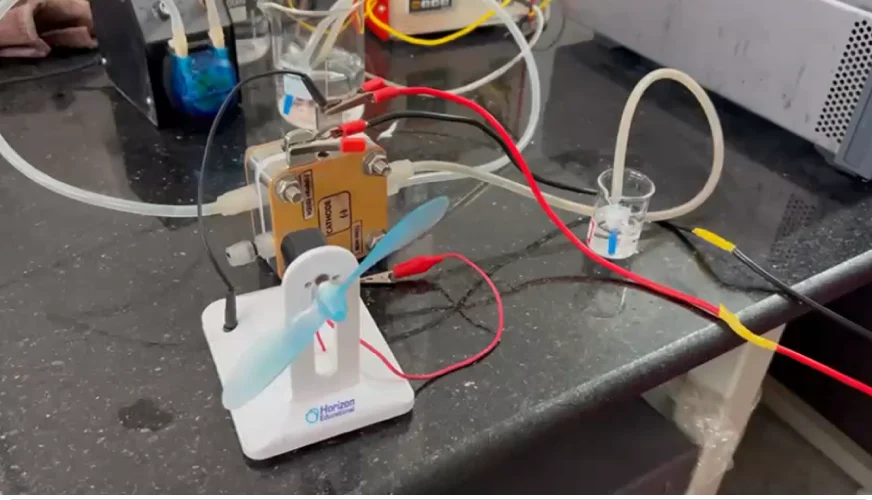
This reference cell is not the final vehicle stack. It is the starting point for large-area cell and multi-cell stack development. See the full polarisation data →
Scale-up is not simple geometric multiplication. Larger cells introduce reactant distribution, sealing, current collection, thermal uniformity and crossover challenges.
Each stage must generate evidence before the next stage is funded. See the development gates →
Ammonia is a toxic industrial chemical and must be handled with disciplined engineering controls. H2ONE's development architecture combines containment, detection, isolation and mitigation.
The first deployment concept is a controlled fleet/depot model, not immediate public refuelling infrastructure. Safety architecture →
H2ONE is using a known electric three-wheeler architecture as the development reference.
Engineering insight: Flat-road power demand is significantly below the 10 kW motor rating. Additional power capacity is required for acceleration, payload, gradient and transient reserve. See the power model →
The model links the measured 25 cm² polarisation data to large-area cells, stack sizing and three-wheeler road load, so each scale-up decision can be checked against the measured cell.
Simulated Model outputs support engineering decisions. They are not measured stack or vehicle performance.